Pieps released their new Pro IPS avalanche transceiver with a soft roll out in their homeland of Austria throughout the winter of 2023 / 24. It is now available worldwide.
We’ve used two Pieps IPS transceivers for a full winter season, accumulating approximately 200 days of use. We train approximately 100 students in avalanche rescue every winter and have done so for the last 15 years: from trainee mountain guides and search and rescue team members through to novice recreational riders. We’ve met with the team at Pieps that added nuisance and insight into the features and the design process that went into the unit.
Out of the box
First impressions are positive. The Pro IPS looks and feels completely different to the beacon you are using now. Its unique feature being its’ fold out aerial that automatically places the unit into search mode. This feature is visually simple for users operating in a high stress situation. By extending the aerial, it’s also moved further away from the electronic magnetic interference (EMI) produced by the transceivers own screen. A lot more on this later.
The quality of the casing materials in the IPS’s construction are also different: a resin which is fibre reinforced for strength. It has an integrated rubberised grip panel that feels ergonomic in the hand, placing the main function button directly under your right index finger: ideal, as long as you’re right-handed. The unit is compact and its slimness is to be welcomed for those who prefer a trouser pocket carry. The power ON/OFF button is physically protected by the closed ariel making it impossible to accidently turn off when in send mode. Pieps state this new casing has gone through rigorous drop testing and 10,000 use cycles, as well as water immersion testing. The IPS feels in a different sphere of quality to previous Pieps models both in design and durability.
 .
The transceiver operates with 3 AAA batteries: no integrated rechargeable battery weirdness for fleet managers to negotiate. Battery life has also been improved greatly from previous models to 600 hours on alkaline batteries and 800 hours on lithium. Fleet managers will also appreciate the ability to carry out annual self-testing via the app without sending their entire fleet away for checking. These features represent a significant fiscal saving for one of our major clients.
Initial set up of the IPS Pro requires blue-toothing the transceiver to the Pieps smart phone app. Downloading and connecting to the app was straight forward. Other reviewers we’ve talked with also commented that the app was user friendly. By setting up with the app, the warranty registration is also completed. More importantly, access to the transceivers advanced ‘Pro’ settings can only be engaged via the app. The app also has a section dedicated to fleet management.
The body harness is easily adjustable and seemed to fit well. Pieps also include a second dynamic cord to allow for a trouser pocket carry, the harness having its stretch cord sewn into it.
The group check mode works similarly to other latest generation transceivers, utilising a 1 metre restricted distance check that is disengaged when the unit is put back into send mode by folding the aerial back down. Group check function is offered with a Yes or No option every-time on powering up with no need to keep buttons pressed down or scroll through a menu.
The buttons on the IPS are well laid out, much better than previous Pieps models and in our opinion any other transceiver currently on the market. The buttons are very firm to engage and cannot be accidently activated. Good. This deliberate firm button engagement means they are difficult to operate when wearing gloves and provide poor physical feedback. Bad. After a season of use they seem pretty bombproof, however, the buttons remain very stiff even with gloves removed.
As with the Pieps BT Pro, haptic feedback is utilised (the beacon vibrates to get your attention at key moments) which is frankly awesome. We’d like to see its use increased in future firmware updates to compliment the poor button feedback.
Segment Display
For those familiar with Pieps transceivers the simple backlit screen layout will be familiar. The IPS screen displays an X alternating with a large ‘AR’ on the screen indicating that it is in auto revert mode which can be disengaged in Pro settings. As a flagship transceiver in 2024 it feels like Pieps has missed an opportunity to upgrade their screen. The Ortovox Diract and the Mammut S and recently released Mammut S2 transceivers feature LCD screens which provide much more detailed information and instructions. Certainly, less is more in low frequency/ high consequence situations, but not if the price is clarity. That said, those familiar with Pieps transceivers will feel at home with the screen interface as it mirrors the rest of their current transceiver range.
Pieps state that the segment display that they employ produces significantly less electronic noise than other displays (LCD’s) currently available on the market. They are looking at producing a segment display which is more user friendly with more user information in future models. Pieps openly state that they have embarked on a mission with the Pro IPS to create a transceiver with the lowest EMI possible signature, to the point of being obsessive.
EMI – Electromagnetic Interference
By creating a transceiver with the lowest possible EMI signature, to the extent of sacrificing features, indeed everything about this beacon is designed in pursuit of reducing EMI, the questions arise: Why? And is it worth it?
EMI is a current hot topic within the avalanche industry with directives being issued by both Avalanche Canada in association with a number of US avalanche forecast centres and the UIAA out of Switzerland. For a sobering insight on the subject as to why EMI is such an issue we recommend reading the Black Diamond QC Labs article highlighting the potential scale of the problem. For example, if you wear heated gloves during a search you can expect a 90% reduction in your transceiver’s search range. ie the transceiver is rendered useless by EMI. Likewise, trying to conduct a search of a large area on a snowmobile is all but pointless due to EMI of the sled. Add a nearby second electronic device to mix, such as a mobile phone or a GoPro and you can see how EMI can morph from a conceptual issue to a real threat to safety.
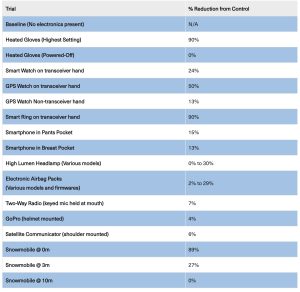
While reducing EMI is important from an interference point for the user, from the manufacturer’s standpoint producing such low EMI in a transceiver has significant benefits: Less EMI in the unit equals an increase in search range. Received signals are identified and interpreted faster and more clearly due to better signal verification, allowing the signal to be followed more directly. At the same time, the technology helps eliminates ‘ghost’ signals (false second signals) when at peripheral search range.
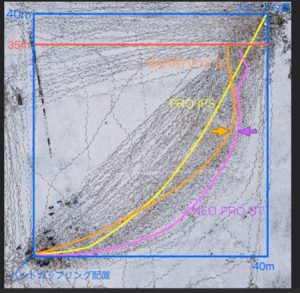
Anecdotal testing carried out by an independent user group in Japan – note the footprint pattern of multiple searchers.
In practical terms from a user point of view, the search pattern size indicated on the screen reduces down from 80m from 20m when the unit detects electronic interference. ‘IPS’ is also displayed on the screen. Pieps still recommends users employ a minimum distance in send mode of 20 cm, and 50 cm in search mode from all electronic, metallic and magnetic objects as is the current industry best standard.
Foraging Deep in the Pro user Woods
Interestingly, a key feature on the IPS unit hasn’t been touted much by Pieps: the upgrade of the scan button that first appeared on their BT Pro model. It’s now a dedicated button that in Pro mode allows toggling between three buried victims. It combines BCA’s Tracker Big Picture mode and Barryvox’s ability to toggle between buried victims. In multiple burial scenarios’ this feature can be a powerful tool for a rescuer in building their mental map of an avalanche scene.
For AvSAR trained users an analogue mode that allows performing sound checks at the 10 metre and 3 metre range to establish how many beacons are transmitting within a defined search area is a valuable tool. The technique is employed as an effective backup to marking failures that occur due to signal overlap in close (<10 metres) and very close (<3 metres) proximity burials.
Also aimed at advanced users is a deep burial feature where the units third antennae calculates the minimum reading is greater than 2 metres and offers an extended fine search display while indicating a ‘deep burial’ on screen.
Analogue mode is disappointing on the Pieps with the analogue volume increments being too great. The IPS produces poor analogue audio feedback when compared to the Barryvox S. It still works in the context of performing the 10 metre and 3 metre sound checks, but in this mode isn’t nearly as intuitive to use as the Barryvox which also provides a digital visual display while providing much more adjustable and nuanced analogue audio feedback when placed in Alternate / Manual (M) mode. This is partly due to Pieps not fitting a hi fidelity speaker on the IPS because…you guessed it, it would increase the units own EMI.
To effectively use the analogue mode for very close proximity burials (two beacons within 3 of each other) we found the best technique was to return to digital mode once the 3m sound check established the correct number of victims within that search zone. This proved to be a simple and effective strategy.
Close Proximity Multiple Burials – Issues?
We noted that at least one user comment that they had an issue with multiple burials and the IPS constantly switched between signals. We conducted multiple very close proximity tests (two transceivers within a 1.5 metre radius) and deliberately didn’t utilise the mark function to simulate a flagging issue. The beacon repeatedly worked as expected, immediately switching from the first ‘found’ unit to the next unit when the second beacon became closer utilising the micro box search technique.
We suspect that users who come from a Barryvox background become confused by the Pieps unit not ‘sticking’ to the first detected buried unit. Pieps and Barryvox have always used different search methodology from each other. One is not better than the other, but users need to be aware that they are different in the way they retain the signals of multiple buried units.
Rob Coppolillo, who also performed an in-depth review of the Pro IPS for the The High Route website found the Pro IPS regularly ‘dropped’ the first marked beacon when carrying out several close-proximity multiple burials during the micro strip stage of the search. (Five transceivers within a 6 metre radius). Rob concluded, this would be a familiarity issue for Patrollers/ Guides who may be more likely to find themselves in a mass casualty situation as opposed to any concern in relation to the effectiveness of the beacon in these scenarios.
We should bear in mind that we are very deep in the woods when discussing such complex burial scenarios: the chances that such an incident could arise and someone appropriately trained will be on hand is unlikely outside of commercial guiding or large resort professional ski patrols. While the Pieps is not as effective as the Mammut S in these very close proximity multiple burial scenarios, if you currently don’t know how to use M mode on the Mammut and don’t train regularly with 10 metre and 3 metre analogue sound checks then this last section is irrelevant.
From an AvSAR standpoint, this is a transceiver I would be happy to use in such a complex search scenario. The Pro scan features’ ability to help build an effective a mental map earlier in the search compensates for the lack of close proximity nuance.
Ease of use in High Stress Situations
During avalanche rescue courses (ARC) we gave the IPS Pro to a mixture of basic and advanced recreational users and deployed them in a variety of avalanche scenarios of differing complexity. User feedback was that they found the basic operation of the unit intuitive, with positive comments about the physical size and hand feel of the unit and its ease of use in its basic non pro set up. While aimed at the professional user the Pro IPS is also an excellent beacon for recreational users who can afford the high price point.
Conclusions
The Pro IPS is a significant upgrade to previous Pieps units. Successful advances have been made in the complete redesign of the physical unit and places itself as one the most effective avalanche transceivers currently available on the market. The EMI handling characteristics of the IPS should factor strongly in the purchasing decisions of transceiver fleet managers whose workforce operate in a heavily electronic polluted environment such as mechanised guiding operations and ski patrollers.
Pro’s
- The unit is very well constructed and robust.
- Fleet manager friendly. Maintenance via app and 600-hour life with standard batteries.
- The scan and toggle features work well & will appeal to advanced users.
- EMI management provides additional resilience and delivers excellent search range.
- DASP technology provides a more direct search approach and helps eliminate ghost signals.
- Haptic feedback.
Con’s
- The segment screen doesn’t display information as well as an LCD screen.
- Analogue mode giving poor audio feedback without visual information.
- Button feel is poor – especially in gloves.
- Reassuringly expensive.
Declaration of Interests
We received two Pieps Pro IPS transceivers in December 2023 from our sponsors Black Diamond UK to provide them in-depth unbiased feedback to the quality and performance of the then new transceivers. Black Diamond is the parent company of Pieps.