Many occupations have a dark side. Politicians are drawn to bribes, rock musicians to recreational drugs, and ski guides to untracked slopes. If safety is paramount in the ski guiding industry, why are so many guides getting avalanched? Are we failing to fully understand the implications of operating in what the economist Nassim Taleb calls the probabilistic fat tail domain?
No matter how sophisticated our choices, how good we are at dominating the odds, randomness will have the last word – Nassim Taleb
We should recognise that Black Swan events will occur with unsettling regularity. They can be visualised in their distribution of probability with a fat tail of extreme and unexpected outcomes. By repeatedly exposing ourselves to these statistical outliers, the size of the margin that we need to afford ourselves on a daily basis becomes disproportionally important. By understanding how fat tails impact on probability, we can see that unusual avalanche events involving mountain professionals are more likely to occur than we believe.
Hi Mike
How are you? I wanted to share an experience with you:
I was involved in a rescue on Wednesday. The second man in our group of three people triggered a big avalanche. 80 meter crown wall, 150 meter slide. Big, fast and scary.
We were lucky. Our guide got there really quickly and was able to clear his airway using his hands. He was buried head first and snow was covering his mouth and he could barely breath but could hear us shouting.
It was disturbing. Have been thinking of it a lot. The horror of watching the initial crack, the propagation, gathering of volume, him getting knocked over and then buried…
Up to 50 cm of new snow the day before and 50 cm the day before that. Avalanche risk 3, poor visibility, unknown bowl to me and my guide. It was mostly 30 degrees in the bowl but we found the only 35 degree slope. We went under a rollover ridge, mostly because the guide got distracted from his planned more conservative route due to another group who were searching having been avalanched themselves… It’s left me shaken, to be sure.
If you survive until tomorrow, it could mean that either a) you are more likely to be immortal or b) that you are closer to death. -Nassim Taleb
The above example illustrates a situation in which mountain professionals can often find themselves. As an isolated decision, it could feel manageable to enter the bowl in the given conditions for an experienced professional with avalanche training; however, over the aggregate of a guiding career, decisions that lack sufficiently wide margins allowing us to reposition our risk exposure will invariably result in being avalanched at some point due to the fat tail of probability.
Avalanches fall within a probabilistic fat tailed domain. (6) They do not fit neatly within a normal Gaussian bell curve of probability. They will regularly produce outliers that over an extended period of time will surprise both avalanche forecasters, and at a slope scale, the mountain professional.
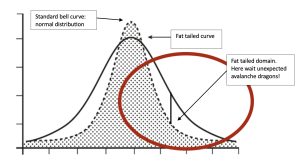 Taleb’s ‘Fat Tail’ distribution curve refers to probability distributions with relatively high probability of extreme outcomes.
Fat tail distribution illustrates that guide mortality does not lay solely within a single flawed decision at a critical time and place, but crucially the environment in which these decisions are being made: when operating in a fat tailed domain our decisions are subject to the variance of outlying and often un-forecasted avalanche events. Our skill set for operating within such a complex system where these outliers reside is likely weaker than we believe it to be.
Avalanche fatalities involving professionals occur over a long winter season and across large geographic areas. The result is an attrition rate that becomes diluted in our consciousness. In a one-month period alone in the Western Alps in 2023, six mountain guides were fatally avalanched.
If we examine the avalanche incident rate of mountain professionals more closely, we begin to understand the scale of the issue. As early as 2002 at a meeting of the International Federation of Mountain Guides (IFMGA) it was indicated that more people died when travelling with a mountain guide than without one. (1)
- In Switzerland over a five-year period, 18% of avalanche victims were being guided. This figure has remained steady over a 20-year period.
- Between 1995 and 2018, a total of 121 French guides died in mountain incidents.
- In France 14% of avalanche deaths included a mountain professional in the group over a 20-year period. (2)
- In North America, figures are similar. Canada’s rate is in excess of 21% (3).
It should be noted that the term ‘guide’ in the above figures encompass all mountain professionals, at all stages of training and experience. The term guide does not represent any single body or particular organization in this article.
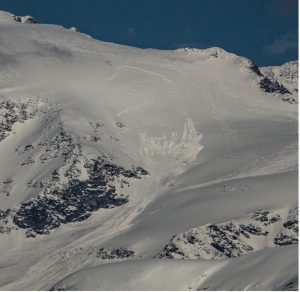 Dome de Miage – Armancette Glacier avalanche: April 2023. Six fatalities including two IFMGA Mountain Guides. The ski tracks to the right of the avalanche provide scale.
Rationalizing these figures, we could argue that exposure to avalanche hazard of guided parties is likely greater than recreational groups. Parties containing a trained professional will often push into more challenging and complex terrain when the avalanche hazard is elevated such as the above example, taking clients where they would not venture without a professional’s expertise at hand. When specifically looking at the mortality rates of mountain professionals, we must also consider the accrual of risk in the aggregate over their . If we play the game long enough, at some point we will encounter the big surprise. This factor of repeated exposure over time is a crucial component of fat tail outcomes. (5)
Fractional Expertise
We can attribute to ourselves a disproportionate degree of understanding when operating in avalanche terrain. Klein and Kahneman refer to ‘fractionalization of expertise’ in their essay A Failure to Disagree. It doesn’t necessarily follow that possessing a strong skiing skill set coupled with the ability to manage clients effectively means we also possess a strong avalanche skill set.
[Kahneman] views the fractionation of expertise as one element in the explanation of the illusion of validity: the overconfidence that professionals sometimes experience in dealing with problems in which they have little skill.
We have a tendency to think of the meta skill as the actual skill, but we can also view it as a compilation of micro skills that we alloy together to create the meta. The skill of reading is a good example: Reading is the meta-skill that results from alloying together a knowledge of the alphabet, how letters form words, how words have meaning. When we’ve amassed all these component skills, we are deemed capable readers, but it doesn’t necessarily follow that we are accomplished at punctuation.
Experience doesn’t necessarily correlate to expertise. The quality of the experience is paramount when gaining expertise. Chago Rodriguez, an Idaho-based avalanche educator, observes that our relationship with snow is very different from one group of mountain professionals to another. If we look at how ski guides gain expertise with the snowpack in contrast to ski patrollers, we can observe interesting comparisons in the structure of their learning.
Ski patrollers and forecasters are avalanche hunters. Guides are avalanche avoiders. By hunting their quarry, patrollers learn to interpret and identify avalanche problems differently. When a patroller rises at dawn for a hundred days every year with the sole aim of triggering avalanches, they engage in a process that over time assists the development of expert intuition.
Conversely, ski guides routinely make consequential decisions in an ocean of uncertainty. Awareness of an avalanche problems’ existence and its distribution is sufficient information to plan their day, effectively avoiding the avalanche problem. A seemingly wise strategy. However, the lack of direct feedback that results from this strategy can inhibit the development of intuition.
Patrollers need to be wary of the implications of interpreting a lack of feedback as a lack of instability, as they are often drowning in direct feedback from repeatedly triggering familiar locations. We know that a lack of positive feedback does not always equate to a lack of hazard.
Neither system of gaining knowledge is necessarily better than the other, but the way these groups gain expertise is certainly different. These methods of different learning provide opportunities for sectors of the industry to learn from each other.
Only a relatively small part of a guides’ training and examination is devoted to negotiating the avalanche maze. While the length and quality of mountain professionals avalanche training varies greatly between differing organizations and nationalities, one commonality is that their avalanche training often courts fractionalization, regularly sitting alone as an educational bolt-on, and not woven throughout their training.
Rodregez, who also provides avalanche courses to aspirant ski guides in Argentina and Chile, argues that training quality can be improved by constant innovation: The equivalent of their Pro 1 avalanche course in South America has a mandatory one-year consolidation period prior to a refresher day, followed by three days of in-field examination. The extended nature of the process helps address fractionalization by removing the ancillary nature of their avalanche education.
Meanwhile, Canadian Guide and lecturer at Thompsons River University, Iain Stewart-Patterson suggests that guide training look more towards basic human behaviours such as reflection and humility and away from solely focusing on technical and physical performance. To date we have shied away from incorporating the assessment of behaviours in guide training. It is perceived as being difficult to quantify and time intensive.
Resilience and Margins
The idea that in order to make a decision you need to focus on the consequences (which you can know) rather than the probability (which you can’t know) is the central idea of uncertainty. Nassim Taleb
When operating in an uncertain and constantly changing environment it’s difficult to establish where the edges of the margins we need to afford ourselves lay or where we are located within that margin. Practitioners in fat tailed domains understand the issue can best be tackled by focusing on the potential consequence of an outlier event then working backwards to set the margin.
Grant Statham describes ski guiding and avalanche forecasting as operating in an “untidy world of uncertainty”. When operating within a complex system, we know from other risk industries that a key way we can manage the unpredictability of outlying avalanche events is through resilience: being ‘antifragile’ as Taleb describes it.
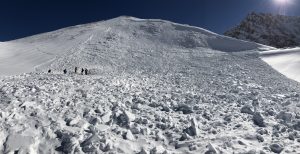 The author at the site of a ski guide-triggered avalanche in the Aosta Valley, Italy. The guide was partially buried and extracted by the author and a passing heli ski operation that witnessed the incident.
Sound risk management improves our resilience to fat tailed outliers by widening our margins. Utilizing Atkins’ Strategic Mind-set model, not just at an operational level but also as individuals, we have already begun to adopt a risk managers mindset as an industry. While it can be reasonable and often desirable in terms of reward to operate in the fat tail domain, by evaluating where ‘safe’ truly sits within the hierarchy of our objectives, we get a useful perspective on our decision-making. After all, even Russian roulette players make money five out of six times.
We should define winning as not losing in the avalanche world. As avalanche practitioners operating in a fat tailed domain, we should solely seek survival, not the accuracy of our predictions. The Canadian guide Bruce Kay zeros in on this view, asserting that ski guides should primarily look at themselves as risk managers:
‘They should be trained in the game of projection not prediction. Operating with clients to a projection is vastly different to operating to a prediction. One is generalised with a margin so large that it allows us the resilience to relocate our risk exposure within it, whereas prediction puts us uncomfortably close to slope scale nowcasting.’
References
(1) Decision making in avalanche terrain ISSW 2004 Iain Stewart Patterson
(2) Sources ENSA & SLF.
(3). Patterns of death among avalanche fatalities: a 21-year review. CMAJ. Boyd J, Haegeli P, Abu-Laban RB
(5) Perception of Risk in Avalanche Terrain 2012 – Kristensen, Genswein & Munter
(6) Large Variance and Fat Tail of Damage by Natural Disaster 2014 – Hang-Hyun Jo and Yu-li Ko
Stretched Exponential distribution in nature & economy: fat tails with scales. 1998 – Laherrere and Sornette
(7) The Role of Intuition in the Decision Process of Expert Ski Guides 2013 – Iain Stewart-Patterson
(8) Incerto Nasim Taleb