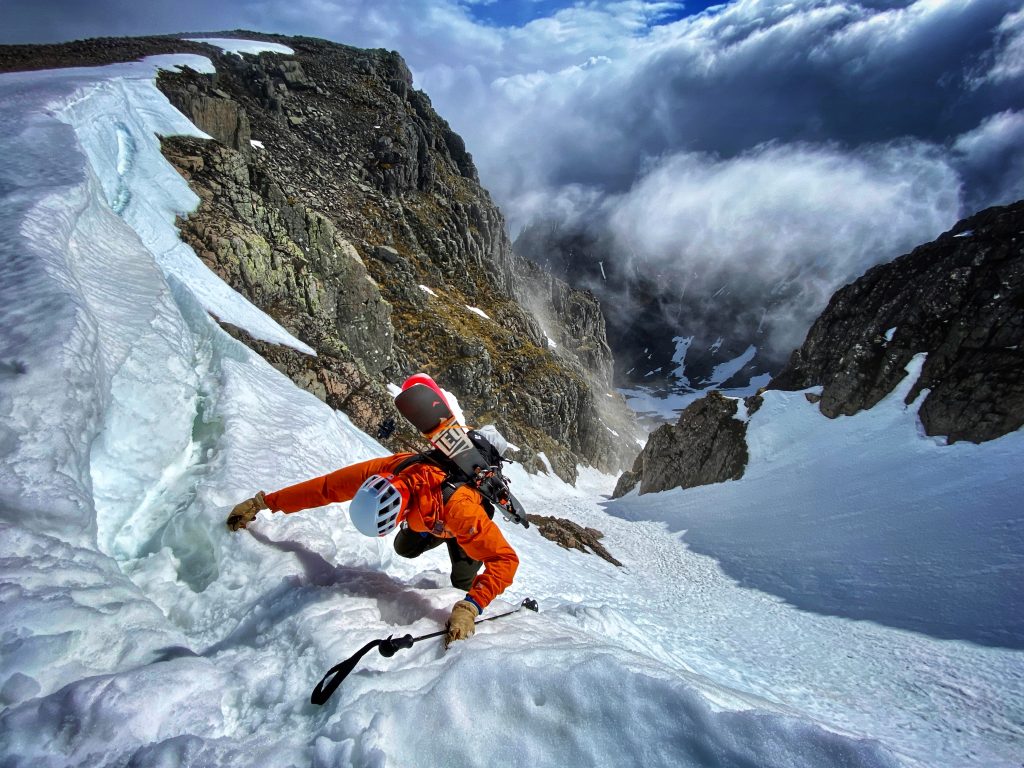
Steep couloir skiing and riding are increasingly popular within the backcountry skiing community. Traditionally the domain of a handful of extreme athletes or winter climbers, steep terrain is becoming more accessible through improvements in ski equipment and availability of route information via the internet. Accessibility has also been improved by the widespread adoption of Toponeige or Volo grading systems(1) that allows relative comparisons of the difficulty of ski lines.
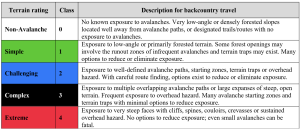
By their nature, couloirs fall within the context of Complex (ATES Version 2: Extreme) classified terrain. They are subject to a high degree of exposure both in ascent and descent, with potentially high consequence outcomes to being caught even by Size 1 avalanches. In simple terms, small avalanches can kill you in couloirs.
This terrain issue is compounded by the limited value of avalanche forecasts when operating in couloirs. Avalanche problems highlighted by the avalanche forecast can vary greatly in couloirs within the forecast zone, both in distribution and reactivity. They are often subject to different loading and temperature regimes to the forecasted terrain. When we consider that avalanche forecasts are at a regional scale, when negotiating couloirs, we must become our own forecasters not just at the slope scale, but at a micro-scale.
Couloir Prevalent Avalanche Problem Types
Dry loose avalanches, consisting of cold unsintered low-density snow, generally require a slope angle greater than 40 degrees, common in couloirs. As skiers and riders, we often trigger dry loose avalanches as sluff in this steep terrain which we can be potentially manage with experience and skill. We should be mindful that this avalanche problem type readily triggers naturally from point releases from rocks both within the couloir itself but perhaps more importantly, from surrounding side walls and cliffs that may feed into our chosen line. Your desired line may be in deep cold shade, but are the surrounding cliffs, perhaps hundreds of metres above and out of sight, catching sun or wind? Without intimate local knowledge it can very difficult to assess this threat from above when in the couloir; prior planning in terms of mapwork or use of binos at an overlook is critical.
A key avalanche problem type prevalent in couloirs is wind slab, particular around gully entrances and aprons where the snowpack often lays on loose aggregates (talus/ scree) whose natural angle of repose falls within the 35-40 degree range: our bullseye slab avalanche angle. By their nature both of these terrain features are often subject to wind slab formation. In maritime climates where weather fronts are usually accompanied with strong winds, for example coastal Norway, there is often a significant difference in wind speed at the base of the couloir, when compared to its top on summit slopes. It has been demonstrated(2) that relative elevation within a couloir plays a key role in snowpack structure.
Dr. Karl Birkeland’s work is extensively published within the avalanche industry; he advised Zach Guy in his MS work on couloir stability at Montana State University:
A person digging a snow pit at the bottom of a couloir during an approach should suspect different conditions higher in the couloir. Likewise, the same concept applies when assessing snow stability from just the top. – Guy & Birkland.
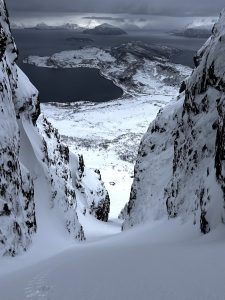
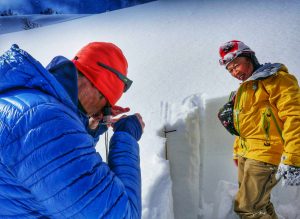
Given the huge elevation difference from top to bottom of many couloirs in the Alps and Norway, often several hundred metres in length, this diversity in the snowpack shouldn’t come as a surprise. Guy & Birkland advocate the use of non-formal testing such as hand shears and ski pole probing to assess the couloir’s snowpack structure in in ascent in combination with overlaying prevailing weather influences and snowpack conditions to create a micro-scale slope assessment.
Are the slopes above us in the couloir’s collection zone potentially actively loading from a depositing wind? A top-down approach gives us more information and the ability to check and manage the problem with ski cuts in this scenario. Conversely, a bottom-up approach allows for wind slab to be identified as we mindfully travel through different elevation zones, allowing the option to turnaround without being overly committed. Whumphing often occurs on the fan, due to what Grant Statham refers to a phenomenon called “spindrift slab”. Where slabs form resulting from all of this sluffing and spindrift coming down the couloir onto the wide fan at their base that is at a prime avalanche angle. This is a common alpine climbing issue on ledges and areas where spindrift accumulates. Statham comments he usually feels relieved once he’s past that part of the approach and into the couloir itself.
Wind slab can also be a consistent avalanche concern when couloir skiing. See below for further discussion of the problem.
Finally, cornices are another avalanche problem type that we typically need to contend with when operating in couloirs. Whilst exposure time to a cornice hazard may be reasonable in descent, it can be completely unreasonable in a bottom-up ascent. Are cornices new, fresh and delicate or old and stubborn? Are they actively loading? Is the afternoon spring sun on their back? Is liquid water present when we conduct squeeze tests in their vicinity?
The Good News
Within an avalanche context opting to ride couloir lines has advantages. Tom Grant is an IFMGA guide based in Chamonix, one of only a handful of guides who specialize in guiding (very) steep ski terrain around Chamonix during the winter months. He views couloir skiing as an opportunity to often mitigate his overall avalanche risk and states he generally feels safer from avalanches when operating in steep corridors.
He finds Persistent Weak Layers are less of an issue in the intermountain couloirs of the French Alps compared to their open slopes, and that the snowpack structure in couloirs is often significantly better than on adjacent slopes due to the deeper, more consistent snowpack often found in them: Snow depth in the gut of a couloir may be 3 meters, whereas snow depth might be half that amount on adjacent slopes at a similar aspect and elevation. Also, he finds he’s less likely to encounter classic trigger points in couloirs such as shallow areas of snowpack or convex roll overs.
Wind distribution of snow within couloirs is likely a key reason why Grant feels more secure within their confines. Little academic research has been done examining snowpack structure in couloirs or specifically looking at steep slopes. The exception being work conducted by Zach Guy with the support of Karl Birkeland(3). Albeit utilising a very limited data set, Guy’s work suggests that layers are more evident and an issue on the windward (shallower) side of couloirs.
Proximity to the windward side of the couloir is a significant variable when added to the model, and the percentage of the snowpack composed of weak layers decreases away from the windward side. – Guy & Birkland
Due to the physical action of regular natural sluffing, it can be argued that the number and quality of distinct layers in the snowpack we find on open lower angled slopes are less likely to be present in steeper couloirs. Anecdotally, Grant finds that a couloir that is constantly sluffing is indicative of a lack of cohesive wind slab above him when ascending. Continuously sluffing snow being funnelled from collection zones physically breaks and sinters crystal forms into smaller, compacted grains, reducing the distribution and reactiveness of problem layers. A form of natural mechanical sintering occurs.
As a result of this mechanical sintering and other processes such as skier compaction, it is perhaps more common to only encounter smaller size 1 ‘pockets’ of instability that affect only a small part of the couloir. For this reason, formal stability tests such as Compression Tests (CT) and Extended Column Tests (ECT) are less reliable as slope scale assessment tools in narrow corridors and lack fidelity on gully aprons and exits with the potential to provide false negative results due to the sluffing/ sintering effect in these locations, although Statham and others find value to testing for windslab on bottom -up apron approaches.
Aggressive roped ski cutting is likely a more appropriate technique for assessing snowpack stability in gully collection zones when top-down skiing, a prime location to encounter wind-slab formation, while regular hand shears and probing for layers of concern and areas of cohesive slab offer us feedback to the top layers of the snowpack when in ascent at the micro-scale.
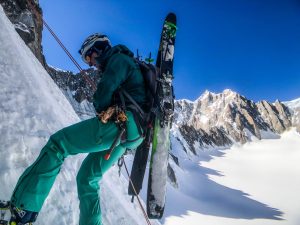
Classic hourglass shaped couloirs, while still falling within the definition of complex terrain, often possess clean run outs onto wide long aprons that allow moving snow to fan uniformly, dispersing the energy and depth of smaller avalanches; potentially less consequential to those entrained in them.
Perhaps the key point Grant makes is that he openly states that he often turns around or amends his plan for the day when setting out to ski steep lines. Over the last several years he has consciously downgraded his risk tolerance when skiing extreme terrain, prompted by many of his contemporaries dying in avalanches. Kristensen & Genswein’s 2012 ISSW paper exploring the repetition of exposure of mountain professionals (4) is even more relevant when constantly repeating our exposure to avalanche hazard in extreme terrain.
A roped top-down approach provides the ability to check and manage potential avalanche problems in key trigger zones.
The Role of Skier Compaction in Restricted Corridors
It’s worth noting that the steep lines around Chamonix where Grant operates can be viewed as anomalous due to the significant amount of skier compaction that occurs in its’ extreme backcountry lines. It can be hard to comprehend how much of a reality this phenomenon exits in popular parts of the Alps. It is not uncommon to negotiate several miles of glacier skiing, followed by steep technical skinning, boot packing, and finally a rappel, only to find your steep line is bumped out!
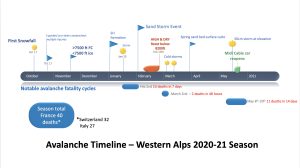
In early May 2021 during Covid two riders were fatally avalanched in the Cosmiques Couloir- a classic 1000-meter trade route- that occurred on the same morning that the Aiguille du Midi gondola granting them access opened for the first time after an extended period of closure.
In a 14-day period following the opening of the lift system accessing high alpine terrain in the French Alps eleven avalanche deaths occurred, many in extreme terrain. It is generally accepted by practitioners of steep skiing around the Alps that skier compaction is a significant mitigating factor in certain locations.
If Persistent Weak Layers are less of an issue in couloirs due to the presence of a deeper and more disturbed snowpack through mechanical sintering and skier compaction then we default to wind-slab being the primary avalanche concern. New snow hiding wind-slab should also feature on our radar when conducting non-formal tests, as this is a byproduct of a deeper snowpack in couloirs that can easily catch us out.
The potential benefit of skier compaction in high traffic areas come at the significant cost of the increase in likelihood of other parties often being present above each other in confined terrain. Being avalanched from above by other parties in popular couloir skiing regions is a growing real and constant hazard and should not be underestimated. Yet another piece of the puzzle to consider in an already complex game.
Strategies for managing avalanche hazard within couloirs are best left to others in different forums. However, it is worth noting that the use of intuition and reliance on a solid skiing and a basic avalanche skillset, fractionization(5), when travelling in couloirs is likely a poor strategy due to their variable snowpack and the high consequence nature of the terrain, that demands more nuanced snowpack assessment techniques beyond those we usually employ when backcountry skiing. Mentorship from those who have a strong and extended background of operating regularly in this subsection of a subsection of skiing is recommended to foster expert intuition with terrain that until recently was deemed the domain of a very small niche group of backcountry riders and skiers.
Here’s a one-pager of key messages that Grant Statham and Parks Canada (Banff, Yoho, and Kootenay National Parks) have developed for couloir skiing. Grant added that they seem to go to a lot of couloir wrecks these days, certainly a few every winter, so the topic is relevant.
Key Messages – Couloirs
- When climbing up stay close together, move from safe spot to safe spot or go one at a time; don’t stop in the middle of the couloir.
- Consider overhead hazards such as rockfall, cornices or other people.
- Climbing up the couloir is useful to check the snow conditions for the descent.
- When starting from the top, kick something onto the slope or do a belayed ski cut to check the snow conditions.
- Ride down the couloir one at a time and plan safe regrouping spots on the side or out of the gully.
- Avoid icy conditions by waiting for the right snow conditions and avoid the couloir if its been scraped down to ice by other parties.
- Handheld radios are a good way to ski one-at-a-time and still communicate.
- Wear a helmet at all times in couloirs – on the way up and down.
- Don’t be afraid to side step, slide slip or jump turn if you need to.
- Be wary of cornices on the ridges overhead and wind loading right at the top of the gully.
- Know how to use of crampons, ice axe and a rope – climbing and riding couloirs requires mountaineering skills.
- Be mindful of the runout zone if someone slips. Rocks, cliff bands, tight gullies or crevasses in the runout zone can really change the consequences of a fall.
References
1 https://aearlyup.net/ski-grade/
2 Guy & Birkland: Relating complex terrain to potential avalanche trigger locations.
3 Guy & Birkland: Spatial variability in steep couloirs – weak layer variation with respect to wind direction. ISSW 2010
4 Kristensen/ Genswein & Munter: Perception of Risk in Avalanche Terrain ISSW 2012
5 Austin: Guide Mortality in Fat Tailed Domains TAR 42.2